Fix
Why is my rock tumbler leaking?
Published
Short answer
A rock tumbler leaks when the lid does not seal: grit on the sealing surfaces, an inner lid not pressed down onto its shoulder, a nut tightened too hard, an over-filled barrel or a worn gasket. Gas pressure inside the barrel can also force slurry out or pop the lid off. Wipe both sealing surfaces, reseat the lid, tighten by hand only and vent a new batch after about 12 hours.
Gray mud under the tumbler looks alarming, but it is nearly always a sealing problem you can fix without parts. It matters beyond the mess: slurry on the rollers makes the barrel slip and stop, and a barrel that loses water grinds poorly. This page covers the two common designs: the rubber barrel with an inner lid, outer lid and nut (Lortone, Thumler's, Highland Park, Harbor Freight) and the kit barrel with a one-piece lid. The causes come from the leak sections of the Lortone and Highland Park manuals, plus standard loading practice.
Rock tumbler leak table: what you see and what to do
Match the leak to a row. Rows run from most to least likely. If more than one fits, clean and reseat the lid first, because that fixes most leaks and needs no parts.
| What you see | Likely cause | What to do |
|---|---|---|
| Gray slurry weeping around the lid from the first hours | Grit or slurry on the sealing surfaces | Open it, wipe the lid edge and barrel shoulder with a damp cloth, reseat the lid. |
| Lid sits crooked or higher on one side | Inner lid not pressed down onto the shoulder | Press the inner lid down evenly until it rests on the shoulder all the way round. |
| Leak got worse after tightening harder | Nut over-tightened, inner lid distorted | Back the nut off. Tighten by hand until snug, never with tools. |
| Barrel bulging, lid popped off, or spray on opening | Gas pressure inside the barrel | Vent it: open slowly, pointed away from you. Check again after 12 hours. |
| Leaks only when the barrel is very full | Over-filled: load above 3/4, water over the rocks | Reduce to about 2/3 full, water just below the top layer of rocks. |
| Thick mud squeezing past the lid late in the run | Slurry has gone too thick | Add a little water, wipe the seal and reseat the lid. |
| Still leaks with a clean, seated, hand-tight lid | Worn gasket, cracked lid or barrel worn thin | Replace the gasket, lid or barrel. |
Rock tumbler barrel leaking at the lid: how to reseat it
Most leaks are a few grains of grit trapped between the lid and the barrel. Silicon carbide is hard and sharp, so one grain is enough to hold a gap open and let slurry seep out for the whole run. Clean and reseat the lid every time the barrel is opened, not only after a leak.
- 1
Wipe the rim of the barrel, the inner shoulder and the edge of the lid with a damp cloth until no grit is left. Run 1 fingertip around the gasket to feel for nicks or hardened slurry.
- 2
Press the inner lid down evenly until it rests on the shoulder all the way round. A lid that sits higher on 1 side will leak.
- 3
Press the outer lid on, fit the washer and turn the nut until it is snug by hand. Use no tools: Lortone and Highland Park both warn that over-tightening distorts the inner lid and causes leaks.
- 4
Dry the outside of the barrel, set it on the rollers and check the lid for wet spots during the first 10 minutes, as the Harbor Freight manual advises.
Note.On a kit barrel with a one-piece lid the same rule applies: clean the rim and the seal, make sure the seal lies flat, and close it firmly by hand.
Over-filled barrels and thick slurry
A barrel filled above 3/4 holds slurry against the lid seal for the whole run and leaves no air space. Keep the load between 1/2 and 3/4 full, about 2/3 as the target, with water just below the top layer of rocks. The grit calculator gives rock and grit amounts by barrel size.
Slurry also thickens as the run goes on, most of all in coarse grit (step 1, 60/90) with soft or crumbly rock. Thick mud is pushed against the lid and finds any weak spot. If the slurry looks like heavy paste when you check, add a little water and reseat the lid. Do not thin it by rinsing into a sink: see how to dispose of slurry.
Why did my rock tumbler explode? Gas pressure
A lid that pops off, or a spray of slurry when you open the barrel, is gas. Gas can build up inside a sealed barrel during a run, more often with glass (as when making sea glass) and with certain stones. A rubber barrel shows it: the bottom or the lid bulges outward. The pressure pushes slurry past the seal, and in a bad case lifts the lid off.
The fix is to vent. The Harbor Freight manual has you check for gas after the first 12 hours and again a day later. Lortone and Highland Park both say to open the barrel from time to time to release it. Stop the tumbler, open the lid slowly, wipe the seal and close it again. For a load that keeps bulging, vent it daily.
Note.A bulging barrel is under pressure. Open it slowly, pointed away from your face, with a rag over the lid and eye protection on.
How to open a rock tumbler barrel when the lid is stuck
On a rubber barrel with a center bolt, take off the nut and washer. Press down on the bolt with a thumb while your fingers lift the edge of the outer lid. If the outer lid will not move, slide the washer between the lid edge and the barrel and twist it to break the grip. Then lift the inner lid out by its bolt. This is the method given in the Lortone manual.
A lid that is stuck after a long run is usually held by dried slurry. Stand the barrel lid-up, run warm water over the joint to soften the dried mud, and work around the edge a little at a time. Do not pry with a screwdriver: a gouge in the rubber or the lid edge becomes a permanent leak.
When does the barrel need replacing?
If a clean, correctly seated, hand-tight lid still leaks on a barrel that is not over-filled, a part is worn. Highland Park calls the inner lid gasket the most common wear part on small rotary tumblers and suggests keeping a spare. Sharp, hard rock wears it faster.
- Gasket or seal: holes, tears, or a flattened and hardened edge. Replace the gasket alone if the maker sells it.
- Lid: cracks, an inner lid warped by over-tightening, or a stripped nut or bolt.
- Barrel: a wall worn thin enough to flex, a pinhole, or a sealing shoulder that is chewed up.
Cleaning up a leak and preventing the next one
Unplug the tumbler and wipe slurry off the rollers, shafts and base before it dries. Slurry on the rollers is a common reason a barrel slips and stops: see rock tumbler not turning. Keep slurry away from the motor vents, and put one drop of oil on each shaft bearing afterwards if they were washed.
- Wipe both sealing surfaces with a damp cloth at every close, even mid-step.
- Tighten by hand until snug. If it leaks, clean and reseat it. Do not tighten harder.
- Fill to about 2/3 of the barrel, with water just below the top layer of rocks.
- Check for wet spots in the first 10 minutes and vent a new batch after about 12 hours.
- Stand the tumbler in a shallow tray, so a leak never reaches the floor or the motor.
Quick answers
Short answers on leaks, popped lids and stuck barrels. Each one points back to a cause and fix covered in the sections above.
- Why is my rock tumbler barrel leaking? Usually grit on the sealing surface or a lid not seated on its shoulder. Wipe both surfaces, reseat the lid and tighten by hand only.
- Why did my rock tumbler explode? Gas built up in the sealed barrel and pushed the lid off. Vent a new batch after about 12 hours and whenever the barrel bulges.
- How do I open a rock tumbler barrel? Remove the nut and washer, press down on the center bolt and lift the outer lid at its edge. Then lift the inner lid out by the bolt.
- What if the rock tumbler lid is stuck? Twist the washer between the lid edge and the barrel, or soften dried slurry with warm water. Do not pry with a screwdriver.
What you need for this
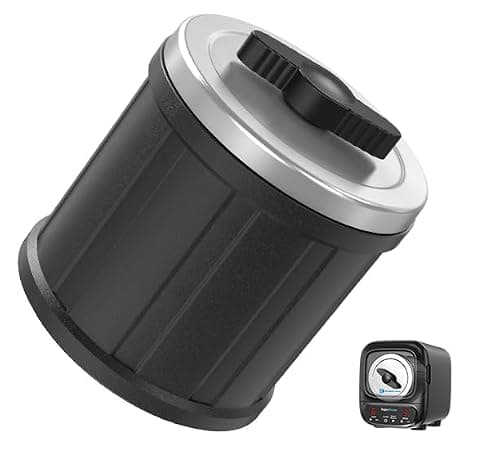 See price on AmazonAmazon
KomeStone K2 Elite rubber barrel, 3 lb
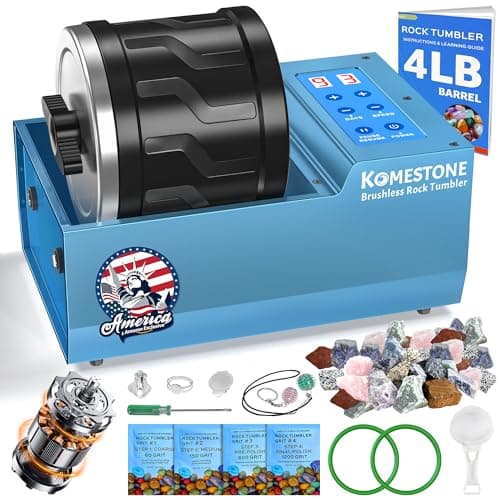 See price on AmazonAmazon
KomeStone G1 rock tumbler kit, 4 lb rubber barrel
From Best rock tumblers for adults: hobby-grade rotary machines
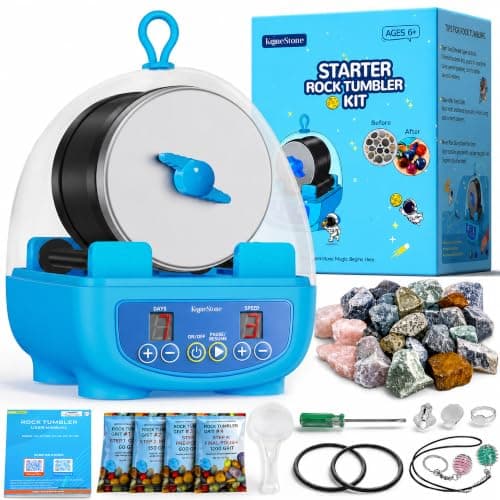 See price on AmazonAmazon
KomeStone K5 kids rock tumbler kit, ages 6+
From Best rock tumblers for kids: kits by age and barrel size