Explainer
Rock tumbler grit substitutes: what works and what fails
Published
Short answer
There is no household substitute that cuts like silicon carbide. Tumbling rocks such as agate, jasper and quartz are about Mohs 7, and an abrasive has to be harder than the rock it grinds. Silicon carbide is about 9 to 9.5. Sand is mostly quartz, also about 7, so it does not cut them. Sand only works on softer material such as glass. Tumbling with no grit just knocks edges off over a very long time.
This page is for two situations: the grit ran out in the middle of a batch, or buying grit feels avoidable when there is sand in the yard. Three things decide whether a material can stand in for grit. It has to be harder than the rock. Its grains have to be sharp, not rounded. And it has to come in a known size, because each step removes the scratches of the step before with a finer grain. The table goes through the usual candidates one by one.
What can I use for rock tumbler grit? Verdict by substitute
Verdicts are for the usual tumbling rocks around Mohs 7: agate, jasper, quartz and petrified wood. Softer loads are noted where the answer changes.
| Substitute | Verdict | Why |
|---|---|---|
| Beach, river or play sand | Fails on Mohs 7 rocks | Mostly quartz, the same hardness as agate and jasper, with rounded grains |
| Coarse sand on glass or soft stones | Works, slowly | Glass is about Mohs 5.5, softer than quartz sand. Gives a frosted finish |
| Aquarium gravel | Fails as grit | Pieces are far too large and smooth to cut. It only fills space |
| Crushed glass | Fails | About Mohs 5.5, softer than the rock. Sharp shards are a handling hazard |
| Baking soda, salt or sugar | Fails | Soft crystals that dissolve in the water. Nothing is left to grind |
| No grit, water only | Barely works | Knocks edges off over a very long time. No smooth surface and no shine |
| Bulk silicon carbide | Works | The same abrasive as kit packets, sold by the pound in graded sizes |
Why hardness and grain shape decide what works
An abrasive scratches only what is softer than itself. Silicon carbide is about Mohs 9 to 9.5, well above the quartz family at 7, so every grain that gets trapped between two stones cuts a little rock away. A material at the same hardness as the rock mostly just rubs. The hardness chart lists where common tumbling rocks sit.
Shape matters as much. Crushed silicon carbide breaks into angular grains with sharp points and edges, and it keeps breaking into new sharp pieces as it wears. Natural sand has been rolled by water and wind until its grains are rounded. Size is the third factor. Grit is sold graded, 60/90 for step 1, 150/220 for step 2 and 500 or 600 for step 3, so each step leaves a finer scratch than the last. A random mix of sizes cannot do that.
Can you use sand in a rock tumbler?
Not on quartz-hardness rocks. Sand is mostly quartz, so sand against agate is Mohs 7 against Mohs 7 with rounded grains. The rocks wear very slowly and come out no smoother than they would from rubbing against each other. The extra weeks of running time cost more in electricity and wear on the machine than the grit they replace.
Sand does work on material that is softer than quartz. Glass is about Mohs 5.5, which is why broken glass tumbled with coarse sand and water for a few days to about a week comes out frosted. How to make sea glass in a rock tumbler has the amounts. Sharp, coarse sand can also wear soft stones such as calcite (3) or fluorite (4), but it is ungraded, so it will not take them to a smooth pre-polish.
Can you tumble rocks without grit?
You can run the barrel with only rocks and water, and the rocks will change a little. Stones of the same hardness knock chips off each other's corners. Over a very long time the sharpest edges go. The faces stay rough, pits stay pits, and nothing in the barrel is fine enough to produce a satin surface, so polish has nothing to work on.
Ceramic media does not change this. It is non-abrasive filler that helps the load roll and carries grit into hollows. Without grit it has nothing to carry.
Note.If you are out of grit for one step, do not skip the step. Rinse the stones, let them dry and store them until the grit arrives. Nothing is lost by waiting.
Aquarium gravel, crushed glass and baking soda
Aquarium gravel is small pebbles, often coated or already rounded. Each piece is many times the size of a grain of coarse grit, so it behaves like more rocks in the barrel, not like an abrasive. Crushed glass looks sharp enough, but at about Mohs 5.5 the rock grinds the glass, not the other way round. It also adds cut hazards at every cleanout.
Baking soda, table salt and sugar come up as DIY rock tumbler grit because they feel gritty when dry. All three dissolve once water is added, so the barrel is left with salty or sweet water and no abrasive. Soap and borax have a real job in tumbling, but it is the optional burnish after polish, not grinding.
- Crushing your own rock for homemade grit gives particles no harder than the rock they came from, plus dust that should not be breathed.
- Wear eye and hand protection whenever glass or rock is broken, whatever it is for.
The cheapest real option: bulk coarse silicon carbide
The grit that runs out first is coarse grit (step 1, 60/90). Step 1 is the only step that shapes the stones, and hard, jagged rough often needs 2 to 4 runs of 7 days, each with a fresh charge. Steps 2, 3 and 4 are run once. So the saving is in buying coarse silicon carbide by the pound and keeping the small packets or a kit for the later steps.
The amount is about 2 level tablespoons per pound of rock in every step. A 3 lb barrel holds about 2 lb of rock and takes about 4 tablespoons. The grit calculator works it out for other barrel sizes, and the grit chart shows the size for each step. Used grit is spent after a run, as explained in can you reuse rock tumbling grit.
Quick answers
The short version of each verdict above. For rocks around Mohs 7, only a graded abrasive harder than quartz does the job.
- Can you use sand in a rock tumbler? Not for agate, jasper or quartz. Sand is the same hardness as those rocks. It works for frosting glass, which is softer.
- Can you tumble rocks without grit? Only to knock edges off over a very long time. The stones will not get smooth and will not polish.
- Is there a DIY rock tumbler grit? No. Household powders are too soft or dissolve in water, and crushed rock is no harder than the rocks in the barrel.
- What are the real rock tumbler grit alternatives? Silicon carbide bought in bulk by the pound. It is the same material as kit packets in a larger bag.
- Does aquarium gravel work as grit? No. The pieces are too large and smooth to cut. They only add volume to the load.
What you need for this
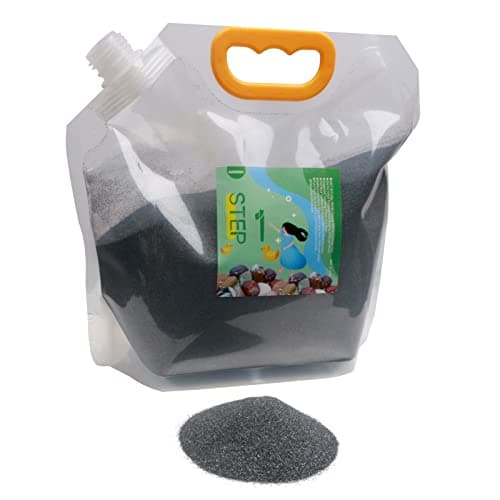 See price on AmazonAmazon
GANGOU coarse grit 60/90, 5 lb in resealable bags
From Best coarse rock tumbler grit: 60/90 silicon carbide for step 1
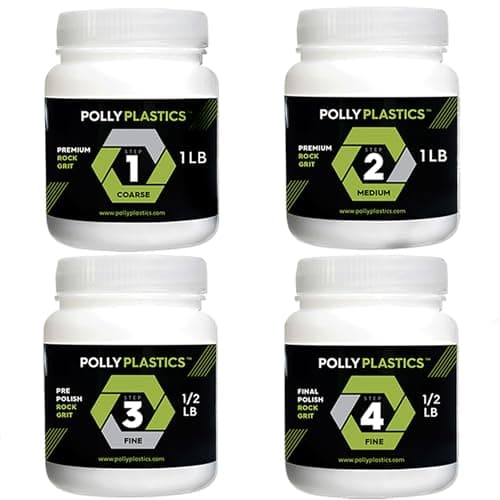 See price on AmazonAmazon
Polly Plastics 4-step grit and polish kit, 3 lb
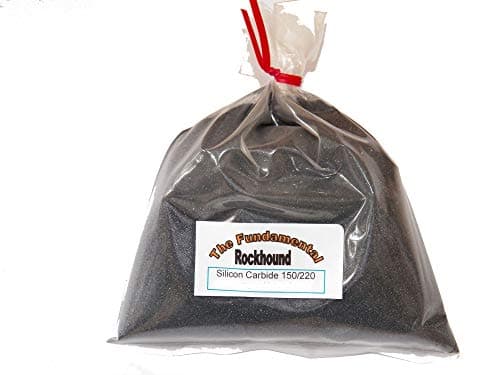 See price on AmazonAmazon
Fundamental Rockhound medium grit 150/220, 5 lb
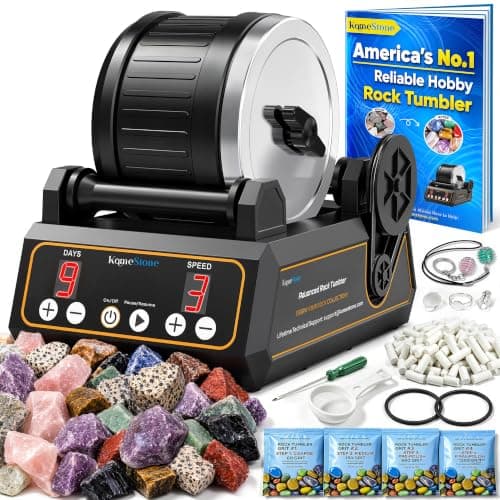 See price on AmazonAmazon
KomeStone K1 quiet tumbler kit, 2.5 lb barrel